
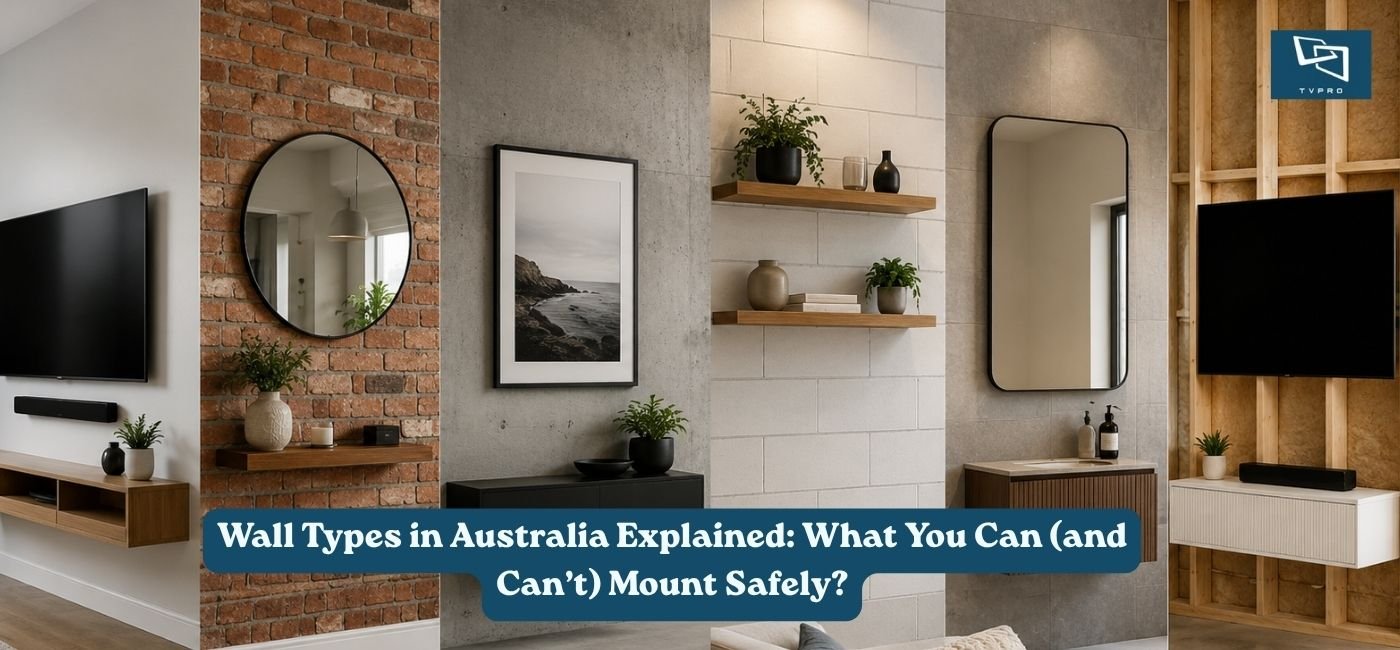
In Australia, one of the biggest reasons wall mounting goes wrong is simple:
people don’t know what wall type they have.
Different walls require different tools, anchors, screws, and mounting strategies.
If you don’t match the method to the material, you invite cracks, collapses, instability — or even expensive repairs.
This guide breaks down every major wall type in Australian homes, what you can safely mount on them, and when you absolutely need a professional.
Let’s get into the nitty-gritty of Australian walls.
1. Plasterboard Walls (Gyprock Walls) — The Most Common Wall Type in Australia
Plasterboard walls (also known as gyprock or drywall) are lightweight and easy to install, but they are NOT load-bearing on their own.
What they’re made of:
- Timber or metal studs
- Plasterboard sheets screwed on top
- Sometimes insulation behind
- Occasionally double-sheeted for soundproofing
What you can mount safely:
✔ TVs (with stud mounting)
✔ Mirrors (with stud or heavy-duty anchors)
✔ Small to medium shelves
✔ Picture frames
✔ Light décor items
✔ Soundbars
What you can’t mount directly into plasterboard:
❌ Heavy cabinets
❌ Large mirrors without studs
❌ Heavy floating shelves without reinforcement
❌ Anything over 10–15 kg using basic wall plugs
Golden rule:
Heavy items MUST be mounted into studs — never directly into plasterboard.
Pros use deep-scan stud finders to locate timber/metal studs before drilling.
2. Timber Stud Walls — Strong & Reliable When Found
Timber studs are extremely common in older and newer homes.
Why they matter:
Studs provide the structural strength required for mounting heavy items.
What you can mount safely:
✔ Large TVs (all sizes)
✔ Floating cabinets
✔ Heavy mirrors
✔ Bookshelves
✔ Gym equipment (light–medium)
✔ Wall-mounted desks
✔ Display units
Challenges:
- Studs are spaced 450–600 mm apart
- Sometimes they are not centred
- You may need a mounting plate for off-centre installations
Professionals know how to distribute weight across studs properly.
3. Metal Stud Walls — Common in Apartments & New Builds
Metal studs are thinner and lighter than timber studs — making them trickier.
What’s possible:
✔ TVs (with special metal-stud anchors)
✔ Shelves (light to medium weight)
✔ Mirrors (with toggle bolts)
Limitations:
❌ Heavy cabinets
❌ Heavy-duty gym equipment
❌ Large bookshelves full of books
❌ High-load mounts
Professionals often use:
- Snap toggles
- M6/M8 metal stud anchors
- Mounting boards for weight distribution
DIYers frequently fail here due to incorrect anchor choice.
4. Double Brick Walls — One of the Strongest in Australia
Found in many older homes, especially in Sydney, Melbourne, and Adelaide.
Strengths:
✔ Extremely sturdy
✔ Excellent load-bearing ability
✔ Great for heavy mounting
What you can mount:
✔ Mirrors of any size
✔ Heavy shelves
✔ Floating cabinets
✔ Large TVs
✔ Display units
✔ Wall-mounted gym bars
✔ Massive picture frames
Considerations:
- Requires masonry drill bits
- Requires proper wall plugs
- Dusty drilling
- Accuracy is important — mistakes are permanent
Pros handle brick walls confidently and cleanly.
5. Cavity Brick Walls — Brick + Hollow Space
These walls have a brick exterior with a hollow cavity inside.
They can safely hold:
✔ TVs
✔ Shelves
✔ Mirrors
✔ Medium cabinets
With the right anchors:
- Chemical anchors
- Sleeve anchors
- Ramset masonry fasteners
Avoid heavy cabinets unless weight is distributed properly.
6. Concrete Walls — Extremely Strong, Perfect for Heavy Duty
Common in high-rise apartments and modern homes.
Ideal for mounting:
✔ Any size TV
✔ Massive mirrors
✔ Heavy cabinets
✔ Thick shelving
✔ Artworks
✔ Gym equipment
Requires:
- Hammer drill
- SDS masonry bits
- Concrete-rated anchors
- High-torque mounting tools
Pros can mount nearly anything on concrete — safely.
7. Hebel Walls — Lightweight but Fragile Without Proper Anchors
Hebel is aerated concrete — lightweight, thermally efficient, popular in modern builds.
But…
Mounting on Hebel requires precision.
What you can mount safely:
✔ TVs (with Hebel-rated anchors)
✔ Mirrors
✔ Light to medium shelves
✔ Soundbars
✔ Clocks
Avoid mounting:
❌ Heavy cabinets
❌ Heavy-duty gym gear
❌ Fully loaded bookshelves
❌ Large floating cupboards
Professionals use chemical anchors or screw bolts designed specifically for Hebel.
8. Tiled Walls — Tricky & Easy to Damage
Common in bathrooms, kitchens, and laundries.
You can mount:
✔ Mirrors
✔ Bathroom cabinets
✔ Floating vanity units
✔ Small shelves
✔ Towel racks
Challenges:
- Tiles chip easily
- Wrong drill bit = cracked tile
- Misalignment ruins aesthetics
- Extra care needed for waterproofing
Pros use diamond-tip drill bits and slow drilling to avoid cracking.
9. Plaster-on-Brick Walls — Common in Older Aussie Homes
These are brick walls covered with plaster — not plasterboard.
Safe for:
✔ Heavy mirrors
✔ Shelves
✔ TV mounts
✔ Cabinets
Notes:
- Requires deep anchor penetration
- Plaster layer may crumble if drilled incorrectly
Professionals handle this wall type confidently.
10. What You Should Never Try Mounting DIY in Australia
Certain items are too risky for DIY:
❌ Large mirrors (15+ kg)
❌ Heavy cabinets
❌ Shelves expected to hold weight
❌ Expensive or fragile artwork
❌ Heavy gym attachments
❌ TVs above 55 inches
❌ Floating desks or vanities
One wrong anchor = expensive repairs or injury.
11. How Professionals Identify Wall Type Before Drilling
Pros come prepared with:
✔ Wall scanners
✔ Deep stud finders
✔ Moisture detectors
✔ Thermal imaging (sometimes)
✔ Tapping techniques
✔ Stud spacing measurements
This allows them to identify:
- Wall composition
- Stud type
- Electrical wiring
- Water pipes
- Load-bearing capacity
- Safe drilling zones
Professionals don’t guess — they know.
Conclusion: Knowing Your Wall Type Is the Key to Safe, Perfect Installation
Every wall in Australia comes with its own rules — and mounting without understanding them is risky.
From plasterboard to Hebel to brick to concrete, each wall demands the right tools, anchors, and technique.
A professional installer ensures:
✔ No cracks
✔ No sagging
✔ No collapses
✔ No guesswork
✔ No safety hazards
Professional wall mounting and hanging services help ensure TVs mirrors shelves and heavy items are installed safely and securely on all Australian wall types.
If you want stable, secure, perfectly aligned wall-mounted items, understanding your wall type — or letting a professional assess it — is non-negotiable.